Wednesday, June 20, 2012

Washington Welcomes Us

We've spent almost a month creeping up the Oregon coast.  It's hard to leave without thinking about our impressions of the state.  We were both impressed with how ecology concious everyone is.  There's an interesting mix of economic levels and a very heady ambiance in the university towns.  The scenery is indescriblable.  Ohhh, the trees...magnificient and so tall.  They even have a tall tree on the license plates.  The logging industry is still going, but it is way past its prime affecting so many of the people here.  Like most water communities, we found the towns to be outdated in a charming sort of way.  Maybe it was the pleasure and enjoyment of life after WWII that these places were developed.  Astoria is a little jewel of northwest Oregon.  Lots going on for a community of just 10,000.  And the most impressive of all:  1.  There's no sales tax so you pay exactly what the price tag says,
                                     2.  It's illegal to pump your own gas.  It's the state's way of creating jobs.
LOVE IT!!!
Now we're in Washington state...though there was no "Welcome to Washington" sign telling us we had arrived.
First stop was at the Mount St. Helen's Nation Monument Visitor's Center.   It's interesting that both the State of Washington and the National Park Service have built centers.  Could it be about $$$?
 The wall photograph as we entered depicts the eruption.
 Photos show Mt. St. Helen's before....
 ...and Mr. St. Helen's after the eruptions that began in May 1980 and lasted for six years.  The main eruptions killed 60 people.
We made a day trip to Olympia and Tacoma.
The state capitol in Olympia was completed in 1928.  They contracted with a New York architectural firm to design the building.  We admired the fixtures and were told that all the lighting is Tiffany. That's Ed on the stairs:
The state seal in the rotunda
 The rotunda 
 Looking down from the second floor
 The Senate chamber
 The House Chamber
 We stopped in the Governor's office to sign the guest book.  We asked to see her but she must have had a busy schedule...
We continued on our day trip and drove the 20 miles to Tacoma to see the Museum of Glass.
Lisa Holloway recommmended it and we are so happy she did!!!
Tacoma is another interesting city.  It's home to more than one university including the
University of Washington and also to the king of glass, Dale Chihuly.  He seems to be revered here.
The Museum of Glass is all about pushing the art medium to new limits.  It's just a spectacular place.
The outdoor reflecting pool is home to a glass sculpture.
 The outside of the building has this huge metal cone.
 It's the Hot Room - the working glass studio.
 Glass artists from all over come here as artists in residence where they work and teach for a period of time.  Some of the resulting pieces are sold in the gift shop.  It's an arena where you watch for hours as they creat beautiful works of art.
 The galleries exhibit rotating shows.  This one of large goblets...
 Some of the designs are sold in the gift shop in "normal" goblet sizes.
 There are combinations of recycled glass, some metal parts, whimsey and traditional glass artistry.  The piece in front is Murano.
One of the galleries is slowing a retrospective of Dale Chihuly's earlier works.  I've gotten so used to seeing his designs everywhere that I've lost my appreciation of his work.  Let me note that I have regained it!  His skills and his artistry and his influence on the studio movement of the last 30 years is immeasurable.  The pieces we saw are wonderful.
 Just look at the colors in this one.
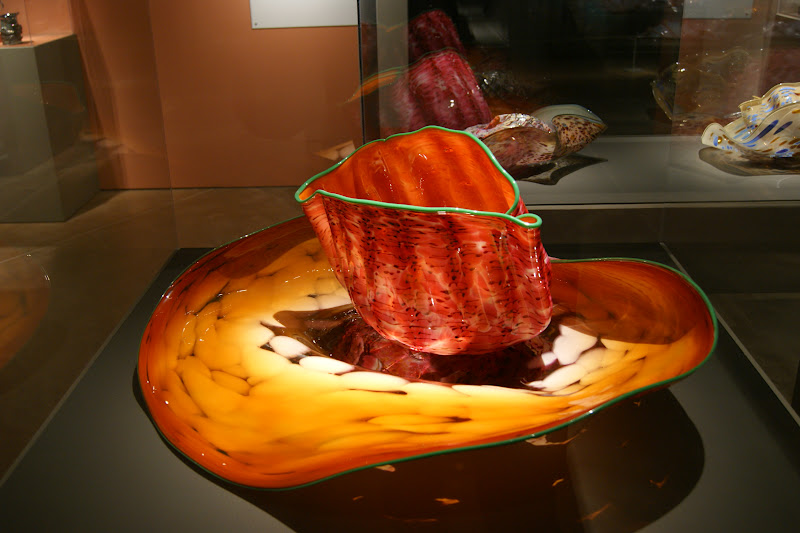
 He has been so immitated., but he's still the master.
 I was taken with these two pieces.  So un-Chihuly.  He has worked in so many genres.
The man who created the pieces below is named Paul Stankard.  He's had a 50 year career in glass art.  We watched a film about his career and his methods - it only made these pieces more remarkable.
He creates the minitures of glass flowers and other life forms and then encases them in molten clear glass.  Each has a spiritual meaning to him and a story. 
 The detail and the beauty if astounding.  Ed was certain the forms were real plants and insects until we watched the film and saw how Stankard creates his glass scluptures.


 This is the artist at work.  This baseball sized piece is for sale in the gift shop.
 Across the road and connected by the Bridge of Glass is the U.S. Courthouse.  There are Chihuly pieces hanging inside.  Old building...new glass...
 The Bridge of Glass is a display of Chihuly works - from the large blue sculptures...
 ...to the window displays of his works.

 One of the pieces displayed - a reclining figure on top.  Not what I thought
of as Chihuly...
What a wonderful time we've had in our introduction to Washiington.  We leave tomorrow to drive up the Olympic peninsula, visit Olympic National Park and then Seattle.

Sunday, June 17, 2012

Clam Hunting in Oregon

 This is what a clam digger looks like.  Clam gun in hand and license in his pocket. 
Up at 4 a.m. to be on the beach an hour before low tide.  There are only about 3 days a month when there's a minus tide which is necessary for clam digging.  It was dark when we got there.

We didn't have a clue what to do so Ed tried his hand and then gave me a chance.  I couldn't move the clam gun, so I got to be photographer and he provided the muscle while both of us hunted for a sign
of a clam - that would be a dime sized indentation or a small pencil hole.
We landed one!!!  These razor clams can be very elusive to beginners like us, but the regulars dig up their daily allotment of 15 in a very short time.
 Then we noticed that everyone else (we were not alone) was out on a sandbar about 1/4 mile down the beach.  We walked down and started picking up hints (lessons) from the more experienced who already had their limit.
 Lots of digging and a few donations from concerned clammers and we were going home with seven.
 I got all the pointers I needed to clean them, flour and bread them and give them a short stint in some olive oil.  They were the most DELICIOUS breakfast I've had on this trip.
We'll do it again tomorrow!!
Clam digging on Day Two!
It had rained all night but was down to just a mist.  We got to sleep in until 5 a.m.and we had learned  we could drive on the beach.  We parked where the others were digging and
 walked out onto the sandbar.
Ed was rarin' to go!
 Some has arrived ahead of us...actually some were leaving with the days catch.
 I spotted the perfect little indentation with a hole, Ed dug down twice and came up with a CLAM. 
Our first without guidance.
 We managed to find one more - on our own - and listened to others tell us that we "had to work for them today,"  The little guys weren't leaving their marks very clearly this morning.
We went back to the RV with our catch of two clams.  I cleaned them and made a clam and goat cheese omelet for breakfast.  Ed had the same...without the clams!

It was fun.  Ed's going to hang the clam gun in the library because we don't know anyone
else who has one.

Exploring the Northwest Corner of Oregon.

We checked into Fort Stevens State Park RV park.  It's the largest of the Oregon State Parks and is full of interesting things to see and do.  We took a walk on the beach to scout the clamming possibilities - but more about that later.  The beach is wide and peaceful - and boasts the Peter Iredale shipwreck.  It's the rusted remains of an English saliling ship that ran aground during a storm in 1906.  It just screams to have it's picture taken...
up close...
...and personal...
...in all its barnacled glory.  I think the beauty is in the isolation on the beach.
We had to photograph this young girl and her dog digging together.  What is it about children and beaches...add a dog and it's magical.
This has been our first foray into Oregon's State Park system - and we've been
quite impressed.
Everything here, except good phone service and wi-fi.    :-(    Even the beach is part of the park. 
Fort Clatsop Lewis and Clark National Historical Park is in the area. 
 Ed's girlfriend is Sacagawea.  She was the indian woman who traveled with
Lewis and Clark.
This entire area is a rainforest.  The lushness still amazes us.
The Corps of Discovery wintered here in 1805.  The original replica lasted 50 years, burned down in 2005 and was rebuilt as it was from Clark's plans.  It was named after the local Indians.
It's surprisingly small, but it kept them warm and alive with help from the indians.
The film in the Visitor's Center was excellent and provided all the background on the expedition.
Seaside is a little town on the ocean about 10 miles from the campground and slightly more from Fort Clatsop.  It's where the Lewis and Clark party set up the Saltworks.  Salt was lifeline to preserving meat and fish. 
Seaside's Historical Society has preserved the site.  Very simple:  Hot rocks boiling sea water in pots 24 hours a day.  What surprised us was how far it is from Fort Clatsop. 
We took Finn and walked a long distance on the boardwalk to the center of town where this statue faces the ocean.
It's a statue of William Clark and Meriweather Lewis.  Ed has a special fascination with this historic event.   He sees it as an amazing expedition with incredible perservance and discipline.  These were hand picked mostly military men.  There were no mutinys, no reported issues, and ALL made it safely home!  It was the first of many truely scientific expeditions to explore America.  Little known fact - Lewis was secretary to Thomas Jefferson and Clark was Lewis' friend and commanding officer in the military.
Art Deco is still alive in Seaside...and we knew exactly when it was going strong.
We drove into Astoria to check it out.  We stopped at the Rusty Cup for some java.  We noticed an interesting old vaudeville theater in the downtown area.  While partaking of our coffee a woman came in to get some lunch.  She turned around, asked us if we had noticed the theater next door and said,  "Want to see the inside?"   Turns out she is the general director.  We picked up our cups and walked next door.  She unlocked the door, turned on the lights, and gave us a tour from stage center.

 The Liberty Theater is still in the throes of restoration.  It had a few incarnations in the 70's and 80's, but is almost back to its former glory and it's beautiful.  Rosemary described it as an "atmospheric" house - being Venetian in design.  (Remember all the Egyptian and Romanesque theaters of the era?)
Here we are Center Stage.  There are just over 600 seats.  Since we arrived the first weekend of the annual month long classical musical festival in Astoria, we're going to try out a couple of those seats on Sunday afternoon.  This was really a special treat!
We were told not to miss the Astoria Column.
Ed climbed the 164 stairs to the top.  Finn was not allowed to go up, so I stayed on the ground to take this stunning photo of Ed. 
The column was dedicated in 1926, underwritten by Great Northern and Vincent Astor.  It sits at the top of Coxcomb Hill on 30 acres with a commanding view of all around it.
The carvings are a summary of the major events in the opening of the west.  Ed reminded me that we saw the Emperor Tragen Column in Rome.  The Astoria Column mirrors the Roman one.
 The view from the site is wonderful.  It overlooks the town of Astoria and bridge to Washington and Cape Disappointment.  The confluence of the Pacific and the Columbia River is 10 miles out.  The National Transportion and Safety Agency declared this bar a hazardous area in 1977.  It's the only area with this designation in the U.S.  All ships going in and out must have a Bar Pilot on board.
Next stop in Astoria - the Columbia River Maritime Museum.
 It's an outstanding museum covering the local maritime history.
This is a model of the Battleship Oregon, used in the 1898 War with Spain.
This museum has a beautiful collection of scale model ships.
We were able to walk into this captains bridge from a Fletcher WWII destroyer.  
 A mid-19th century whaling ship.
 A 16th century ship, the Hind, that explored America.
There's a beautiful scrimshaw display,  Yarn winders haven't changed at all, but they aren't made of whalebone anymore.
 The Lightship Columbia is part of the Maritime Museum.  We were able to go all through her.  The museum volunteer on duty, Bob, was a wealth of information having spent more than 30 years as a volunteer.  He sensed Ed's interest and spent quite a bit of time talking with us.
This ship was a lighthouse.  She was anchored 5 miles out and the crew came to her.  She was taken out of service and replaced by the floating lights like the one in the front of her.  She served almost 50 yrs.
While we were there, Bob pointed out 2 grainships - one from Japan.  They go up the Columbia River picking up grain.  They were very high in the water indicating they were empty.
Fort Stevens was a military fort to protect the Columbia River basin from attacks.  The concern was that during the Civil War, Canada or Great Britain would take advantage of the conflict back
East or attempt to settle old scores in the Pacific Northwest.  It was established in 1862 and kept in operation until 1947.  It's heydays were during WWII when the Oregon coast was attacked by a Japanese light bomber which took off from a submarine.  There were other attempts to bomb the West coast by the Japanese using helium balloons.  But, we knew all about helium bombers  being from the balloon captial of the world.  ;-)

 When we arrived at the museum, there were Civil War reenactors preparing to fire cannons.  The first was a brass Napaleon light cannon.  I made friends with one of the officers and was rewarded with a front row seat.
 The large cannon was fired later in the day, but we weren't there.  All the reenactors looked at this photo and were impressed that it captured the smoke from the priming port as well on the front.
I went off to work on this blog (!) and Ed returned to visit the rest of the site and small museum.

The fort is about 1/4 mile long.  The section houses a retracting cannon that is visible on the right.  It was designed in the late 19th century to fire over the parapets of the fort and retract for reloading.  It completely protected the occupants.
Here's a close-up of it in the retracted position.

The gun was called the Battery Pratt.

There's a working model in the museum showing the firing sequence and sweeping motion of the gun.

This photo was taken from the top of the parapets of the fort and in front of Battery Pratt facing the Columbia River.  This is the area they covered.


Tomorrow:  Washington state!